
树状数组
树状数组是一种特殊的高效数据结构:时空复杂度和线段树类似,但是它的系数要小的多。树状数组是一个查询和修改复杂度都为
树状数组的推导
若正整数
它们的长度分别为
同时,我们发现如果区间以右端点
由此,区间
for (int i = x; i; i -= lowbit(i)) {
    // 区间 [i - lowbit(i) + 1, i]
	printf("[%d, %d]\n", i - lowbit(i) + 1, i);
}
而树状数组就是基于上述思想的一种数据结构,其基本用途就是维护序列的前缀和。
设数组
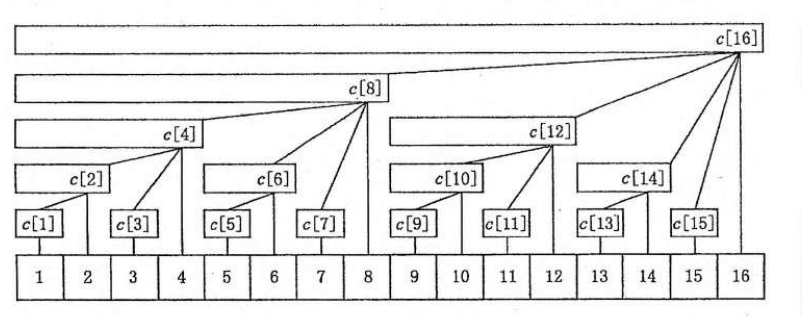
由上图我们可以推出:
的最后一个元素必是 。 的子节点个数为 的位数。 - 除树根外,
的父节点为 。 - 树的深度为
,其中 为序列元素个数,当 不是 的整数次幂时,树状数组是一个森林结构。
两个基本操作
1. 查询前缀和
查询序列
int query(int x) {
    int res = 0;
    for (int i = x; i; i -= lowbit(i)) res += c[i];
    return res;
}
如要查询区间
2. 单点增加
单点增加即对序列
void add(int x, int y) {
    for (int i = x; i <= N; i += lowbit(i)) c[i] += y;
}
树状数组的初始化
初始
树状数组的实际应用
1. 树状数组模板
#include <bits/stdc++.h>
using namespace std;

const int N = 5e5 + 10;
int a[N], c[N], n, m;

int lowbit(int x) {
	return x & -x;
}

void add(int x, int y) {
	for (int i = x; i <= n; i += lowbit(i)) c[i] += y;
}

int sum(int x) {
	int res = 0;
	for (int i = x; i; i -= lowbit(i)) res += c[i];
	return res;
}

int main() {
	cin >> n >> m;
	for (int i = 1; i <= n; i++) {
		cin >> a[i];
		add(i, a[i]);
	}

	while (m --) {
		int op, x, y;
		cin >> op >> x >> y;
		if (op == 1) {
			add(x, y);
		} else {
			cout << sum(y) - sum(x - 1) << endl;
		}
	}

	return 0;
}
2. 求逆序对
问题分析:
- 在序列
的取值范围上建立树状数组,初始全为 。 - 倒序扫描序列
,对于 ,查询树状数组中 的和,即 ,即为 的逆序对个数。 - 更新树状数组,
。
#include <bits/stdc++.h>
using namespace std;

const int N = 1e5 + 10;
int a[N], c[N], n;

int lowbit(int x) {
    return x & -x;
}

void add(int x, int y) {
    for (int i = x; i <= N; i += lowbit(i)) c[i] += y;
}

int query(int x) {
    int res = 0;
    for (int i = x; i; i -= lowbit(i)) res += c[i];
    return res;
}


int main() {
    cin >> n;
    for (int i = 1; i <= n; i++) cin >> a[i];

    long long res = 0;
    for (int i = n; i > 0; i--) {
        res += query(a[i] - 1);
        add(a[i], 1);
    }
    cout << res << endl;

    return 0;
}
如果序列
#include <bits/stdc++.h>
using namespace std;

const int N = 200010;
long long a[N], n, c1[N], c2[N], r1[N], r2[N], l1[N], l2[N];

void add(long long c[], long long x, long long y) {
    for (; x <= N; x += x & -x) {
        c[x] += y;
    }
}

long long query(long long c[], long long x) {
    long long ans = 0;
    for (; x; x -= x & -x) ans += c[x];

    return ans;
}

int main() {
    cin >> n;
    for (int i = 1; i <= n; i++) {
        cin >> a[i];
    }

    for (int i = n; i >= 1; i--) {
        r1[i] = query(c1, N) - query(c1, a[i]);
        add(c1, a[i], 1);

        r2[i] = query(c2, a[i] - 1);
        add(c2, a[i], 1);
    }

    memset(c1, 0, sizeof c1);
    memset(c2, 0, sizeof c2);

    for (int i = 1; i <= n; i++) {
        l1[i] = query(c1, N) - query(c1, a[i]);
        add(c1, a[i], 1);

        l2[i] = query(c2, a[i] - 1);
        add(c2, a[i], 1);
    }

    long long ans1 = 0, ans2 = 0;
    for (int i = 1; i <= n; i++) {
        ans1 += r1[i] * l1[i];
        ans2 += r2[i] * l2[i];
    }
    cout << ans1 << " " << ans2 << endl;;

    return 0;
}
树状数组的扩展应用
1. 区间增加,单点查询
问题分析:结合差分的思想,维护指令的影响即可。
#include <bits/stdc++.h>
using namespace std;

const int N = 1e5 + 10;
int n, m, a[N], c[N];

void add(int x, int y) {
    for (; x <= N; x += x & -x) c[x] += y;
}

int query(int x) {
    int ans = 0;
    for (; x; x -= x & -x) ans += c[x];
    return ans;
}

int main() {
    cin >> n >> m;
    for (int i = 1; i <= n; i++) {
        cin >> a[i];
    }

    while (m--) {
        char op[2]; cin >> op;
        if (op[0] == 'Q') {
            int x; cin >> x;
            cout << a[x] + query(x) << endl;
        } else {
            int l, r, x; cin >> l >> r >> x;
            add(l, x);
            add(r + 1, -x);
        }
    }

    return 0;
}
2. 区间增加,区间查询
在上一题中,我们使用树状数组维护了一个数组 C l r d,我们令
上式可以改写为:
由此,在本题中我们维护两个树状数组
对于 C l r d,我们令
对于 Q l r d,我们令
#include <bits/stdc++.h>
using namespace std;

const int N = 1e5 + 10;
long long a[N], c[2][N], s[N];
int n, m;

int lowbit(int x) {
    return x & -x;
}

long long query(int k, int x) {
    long long ans = 0;
    for (int i = x; i; i -= lowbit(i)) ans += c[k][i];
    return ans;
}

void add(int k, int x, int y) {
    for (int i = x; i <= n; i += lowbit(i)) c[k][i] += y;
}

int main() {
    cin >> n >> m;
    for (int i = 1; i <= n; i++) {
        cin >> a[i];
        s[i] = s[i - 1] + a[i];
    }

    while (m--) {
        char op[2];
        int l, r, d;
        cin >> op >> l >> r;
        if (op[0] == 'Q') {
            long long ans = s[r] + (r + 1) * query(0, r) - query(1, r);
            ans -= s[l - 1] + l * query(0, l - 1) - query(1, l - 1);
            cout << ans << endl;
        } else {
            cin >> d;
            add(0, l, d);
            add(0, r + 1, -d);
            add(1, l, l * d);
            add(1, r + 1, -(r + 1) * d);
        }
    }

    return 0;
}
请同学们课后完成: